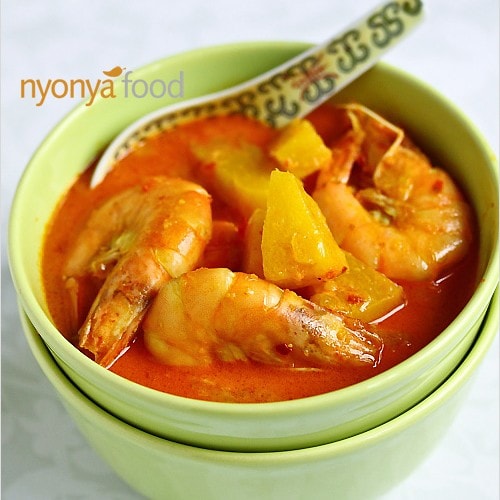
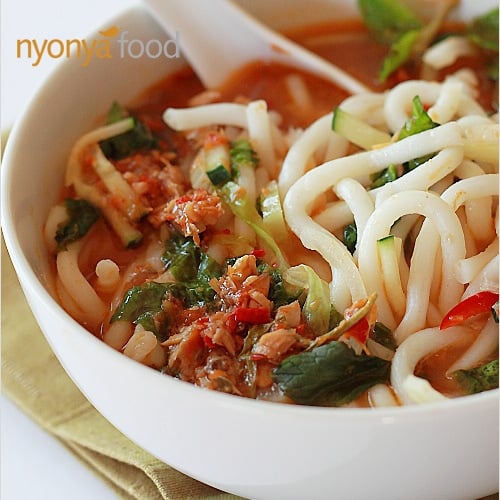
Perut ikan—literally means fish stomach—is a signature Nyonya specialty that I love very much. The thought of it often sets my stomach rumbling and mouth watering. As unappetizing as it sounds and perhaps a tad weird to many, Perut ikan is a curry-like dish of various vegetables, aromatic herbs, and fermented fish stomach in the bath of rich, savory, sweet, sour, and spicy goodness. My pictures do no justice to this wonderful dish.
During my recent trip home to Penang, I learned the preparation of perut ikan and other Nyonya delicacies from my aunt. (My aunt’s perut ikan is the best; you just can’t get the same quality at Nyonya restaurants.) For once, I was the chef in her kitchen, cooking up a storm while she patiently narrated the step-by-step of making Nyonya dishes.
“Tumis (sauté) your spice paste until fragrant and add in the fermented fish stomach. This is a very important step as it rids the fishy smell from the fish stomach…that’s why coriander seeds are a must in the spice paste, without them, it’s not perut ikan…”
“Ok ok…”
“Now, add in some water and bring it to boil before you toss in the pineapples, green beans, and eggplants…”
“What about these daun kaduk (leaves) and aromatic leaves, can I add them in now?”
“No. You have to wait. You need to imbue the curry with the sourness of the pineapples first. Add those aromatic leaves towards the end or they will turn too mushy. It’s about balancing the taste and the texture of the ingredients…and don’t forget the santan (coconut milk).”
I was enlightened and nodded my head in agreement.
And so I listened carefully. I memorized. I learned.
Nyonya cooking is not to be taken lightly; a misstep in the cooking process or mishandling of the ingredients will render the dish unsuccessful.
No longer was I the child standing beside my aunt who watched curiously as she was cooking her dishes. Over the years, my aunt has aged physically but her skills in making Nyonya food has only gotten better. And now, I must be taught and become skilled at all these nostalgic foods of my childhood…
Excerpt from Wikipedia:
Nyonya food is the food of Peranakan people of Malaysia and Singapore. It uses mainly Chinese ingredients but blends them with Southeast Asian spices such as coconut milk, lemon grass, turmeric, screwpine leaves, chillies and sambal. It can be considered as a blend of Chinese and Malay cooking.
Recipe: Perut Ikan (Nyonya Preserved Fish Stomach with Herbs and Vegetables Curry)
Ingredients:
Spice paste
1 stalk lemongrass
6 shallots
8 dried red chilies
3 slices of galangal
1 inch of turmeric
1 tablespoon of roasted belacan
3 tablespoons of coriander seeds
6 pieces of fermented fish stomach
10 green beans (cut into 2 inches length)
1 egg plant (cut into small wedges)
1 small ripe pineapple (cut into 2 inches sticks)
1/2 lb small shrimp
5 chilies (slit and cut into 2 inches length)
1 ginger flower (sliced finely)
10 kaffir lime leaves (sliced finely)
30 daun kadok leaves (sliced finely)
20 sprigs polygonum leaves (use only the leaves)
20 sprigs of mint leaves (use only the leaves)
1 cup coconut milk
Tamarind Juice
Mix tamarind pulp (about the size of a small ping pong ball) with warm water, soak for 15 minutes and extract the juice.
Blend the spice paste with the a food processor, set aside. Heat up some oil in the wok and sauté the spice paste until fragrant. Add in the pickled fish stomach pieces and stir well with the spice paste. Add in 5 cups of water and bring it to boil and toss in the long beans, pineapples, egg plant, ginger flower, and red chilies. Simmer for 15 minutes. Add in the coconut milk, small shrimp and the herbs and simmer for another 15 minutes. Add salt to taste. Serve hot.
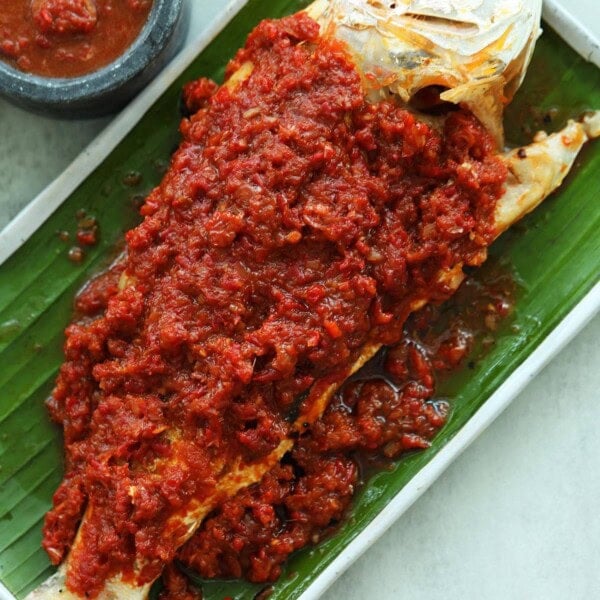
A true Malay classic, ikan panggang/ikan bakar (grilled fish wrapped in banana leaves) is very popular in Malaysia. Marinated with dollops of spice paste, the fish is wrapped in banana leaves and grilled to perfection over charcoal fire.
The smell of burnt banana leaves imparts the fish with a smoky flavor and the spice paste infuses the fish fillet with layers upon layers of spicy taste.
Ikan Panggang/Ikan Bakar is usually served with sambal belacan with sliced shallots. I love the sambal as it adds that extra kick to this wonderful street snack.
The key ingredient of ikan panggang/ikan bakar is the chili paste. I used dried chilies, turmeric, shallots, galangal, lemon grass, and a little bit of belacan as the marinate. For the fish, stingray wings/skate wings are ideal, but I substituted it with a sole fillet (you can also use any flat fish).
Preparation might take some time; you will need to pound the spice paste, wrap the fish with banana leaves, marinate it overnight (preferably), and make the sambal condiment. But as you open up the banana leaves and the inviting aroma of the grilled fish fills your kitchen, you will realize that the end result is well worth the effort.
Don’t you agree?
Note: I grilled the fish with a Wolfgang Puck indoor grill because it’s cold now and I do not want to set up an outdoor grill. You can buy the indoor grill here.
Recipe: Ikan Panggang/Ikan Bakar (Grilled Fish Wrapped in Banana Leaves)
Ingredients:
1/2 – 1 lb of fish fillet
Spice Paste
1 clove garlic
3 shallots
6 dried chillies
1 tablespoon of turmeric powder
1/4 teaspoon of toasted belacan
2 inches of lemon grass (white part only)
1 inch of galangal
1/4 teaspoon sugar
1/8 teaspoon salt
1 tablespoon of oil
1 tablespoon of lemon juice
Tamarind Juice
8 tablespoons of water
Tamarind pulp (size of a small ping pong ball)
Sambal Belacan and Sliced Shallots Condiment
3 red chilies (deseeded)
2 bird’s eye chilies (deseeded)
1 teaspoon of toasted belacan
2 shallots (thinly sliced)
1/8 teaspoon of sugar
Method:
- Using a mortar and pestle or food processor, blend the spice paste.
- Clean the fish and pat dry. Coat the fish with the spice paste evenly and wrap it with banana leaves. Use toothpicks to hold the banana leaves so the fish is wrapped tightly. Leave the parcel in the refrigerator and marinate overnight.
- For the tamarind juice, soak the tamarind with water for 15 minutes and extract the juice.
- In a mortar and pestle or food processor, pound/blend the red chilies, bird’s eye chilies, and toasted belacan.
- Add tamarind juice and sliced shallots to the sambal. Stir well.
- Heat up your grill and grill the fish parcel for 5 minutes on each site (or until the banana leaves are burnt).
- Serve hot with the sambal condiment.
Curry Puff–a snack filled with curried potatoes commonly found in Malaysian and Singapore–has been a hit in my circle of food blogosphere recently. Simcooks kicked off the craze for curry puff and did a “super-size-me” version; Budding Cook quickly followed with her rendition. Lured by these munchies, Keropok Man rushed out to his favorite joint [...]
My mother is a fantastic cook. Coming from a small fishing village in the state of Kedah, she makes killer dishes with seafood, especially Chili Crab. With this post, I give my utmost tribute and applause to my mother for her cooking skills and this very special family recipe.
Growing up, I would always look forward [...]
For the hungry eyes such as this, this, and this, please ogle your food porn. And while you are at it, wear a napkin around your neck. (Rumor has it that a certain uncle is contemplating a new career in tissue paper manufacturing, specially for Rasa Malaysia readers!)
For the budding cook and serious cooks such [...]
Assam Pedas, or literally “sour spicy,” is a classic Malaysian dish. Ask any home cooks in Malaysia–Malay, Chinese, or Indian–and you are bound to get various recipes for Assam Pedas. Everyone has their own interpretation for this favorite dish and there are endless adaptations; suffice it to say, it’s sour, fiery hot, and tastes extraordinarily [...]
As a self-proclaimed Malaysian home cook, it’s a shame that it took me so long to prepare nasi lemak, the de facto national dish of Malaysia. In my opinion, a truly remarkable nasi lemak is not to be taken lightly; it should fulfill a few requisites: quality, texture, flavors, and, of course, the right ingredients. [...]
One of my favorite Malay kuih-muih (local cakes and sweet treats) is Cucur Badak. Much like many other Malaysian creations, Cucur Badak calls for really basic ingredients–sweet potatoes, flour, and grated coconut–but it’s the preparation method of these everyday ingredients that makes the taste ingeniously flavorful.
If you’ve tried Pulut Udang before, you will get the [...]