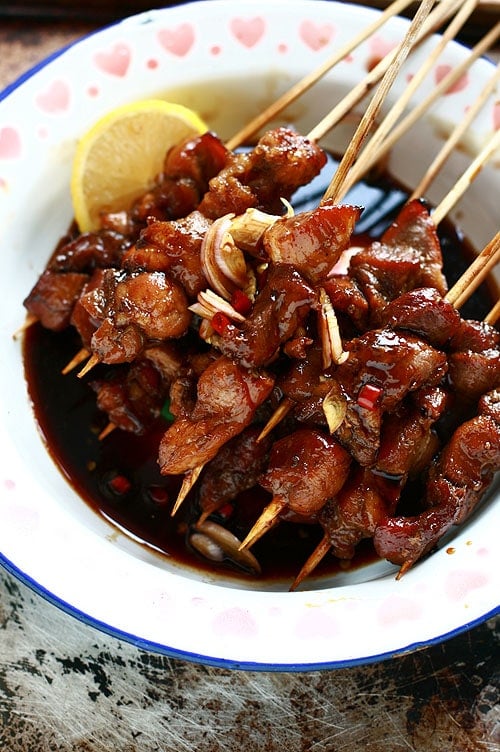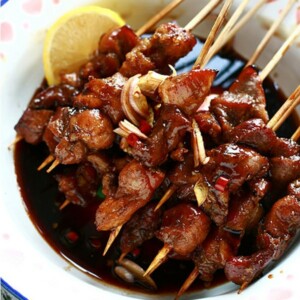
Indonesian Sate (Sate Babi and Sate Ayam Bumbu Kecap/Kacang)
November 5th, 2009Recipes, Indonesian Recipes, Recipes33 Comments
The sticks: (check out the step-by-step pictures in the gallery above)
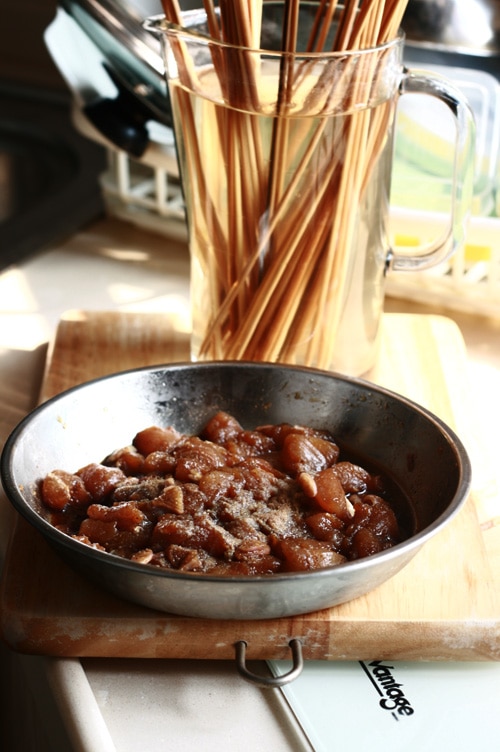
Remember to soak those bamboo skewers in water for at least 1 hour to prevent them from burning later. I soaked mine for a good few hours; they kinda look good in the vase, eh? I should use them to decorate my flat.
The marinate:
I made two versions of sate, pork and chicken. It is best to get meat with a good amount of fat in it; the fatty bits will make the sate tender and juicy. However, if you’re on a low fat diet (hold your tears), no worries. I made a few sticks of lean and mean sate made of skinless, boneless chicken breasts for sous chef, who’s on a low fat diet, and my other friends ended up eating them too. They were that good.
Cut your meat into bite sized cubes, and marinate with:
- a good sprinkle of garlic salt
- a couple dashes of ground paprika
- a dash of white pepper
- 2 tsp ground coriander seeds
- 2 tsp ground nutmeg
- 1 tsp cumin
- 1 tsp olive oil
- 2 cloves of shallot, thinly sliced
- A dash of soy sauce
- Lots of kecap manis (Indonesian sweet soy sauce). You want them to be almost drowned in this.
Marinate for a few hours, or for best result, let it marinate overnight in the fridge.
The skewering:
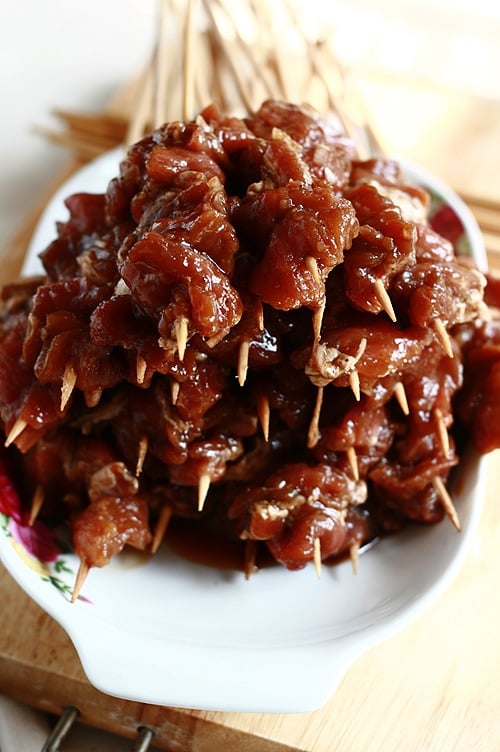
The next day, stick the meat cubes with the bamboo skewers. I stick 4-5 pieces of meat cubes per sate. If you’re using meat with fatty bits, mix fatty and lean meat cubes in each skewer.
The grilling and basting:
I made the sate for a BBQ party, so I could grill them on a charcoal grill, which is the best scenario. However, if you don’t have one, it’s not the end of the world; you could make a pretty decent sate with an oven. Simply preheat oven to 200C, place the sate sticks on a baking sheet and grill them until you see some burnt bits. Please do not deep fry some sticks of meat and call them sate, pretty please?
Before grilling, squeeze a bit of lime juice over the sate.
While grilling, baste the sate with a mix of:
- kecap manis (sweet soy sauce), this should be the dominant flavor
- a dash of fish sauce
- a clove of thinly sliced shallot
- juice of half lime
The sates are done when the meat feels a bit firm (not rock hard), shrunk a bit, and beautifully caramelized.
The sauce:
I made two different sauces. One is kecap manis sauce, which is the same as the baste and peanut sauce.
- 1 cup of roasted peanuts (or use crunchy peanut butter)
- 1 clove of garlic
- 2 cloves shallot
- 1 tsp ground cumin
- 2 tsp ground coriander seeds
- 1 small block of palm sugar (or replace with brown sugar)
- Salt, white pepper, a bit of olive oil
Process everything in a food processor until well mixed.
To serve, place the peanut sauce on a plate, add a dash of fish sauce, drizzle generously with kecap manis, and squeeze juice of a lime. I omitted chili from the sauces as some of my friends don’t eat hot food. Feel free to add one of two freshly chopped chilies in the sauce.
Bathe your freshly grilled sate in one of the sauces and serve (optional = serve with steamed rice or lontong/rice cakes).
Warning! Highly addictive, super popular, you might never have enough sate. Serve these babies in a friend’s party, and your friends will keep inviting you (or maybe just your sate).
A million thanks to Rasa Malaysia for inviting me to blabber in this beautiful blog of hers. I am so honored!
Get More Delicious Recipes Below:

Sate Lilit Bali Recipe
Sate (Indonesian spelling) or Satay (Malaysian spelling) is one of the most loved foods in Southeast Asia. Today, I have the talented Dhi at Cooking Etcetera as a guest writer on Rasa Malaysia. In collaboration with Pepy of Indonesia-Eats, both of them will be writing about “Highlights of Indonesian Cuisine” and start the series with Indonesian sate. I am personally…

Nasi Goreng Recipe (Indonesian Fried Rice)
Nasi goreng or Indonesian fried rice is one of the most requested recipes on Rasa Malaysia. I have received many emails from readers requesting for a nasi goreng recipe. For those who are anxiously awaiting a nasi goreng post, wait no more as I have gotten just the perfect nasi goreng recipe for you. Adapted from James Oseland’s Cradle of…

Mie Goreng (Indonesian Fried Noodles)
I have been so busy recently I can hardly find any time to have a breather. If you’ve been following my blog and Twitter, you will know that working on my cookbook has pretty much consumed all my time. As a result, I have been eating out more, and cook only when time permits. In the past, I would always attempt…

Balinese Chicken (Ayam Pelalah)
As you might have guessed, my favorite region in the whole world is Asia. And of all Asia, my favorite island is Penang, my hometown, and my second favorite is Bali, Indonesia. I love Bali—its lush green fields, Hindu temples, rolling highlands, sandy beaches, rich culture, and friendly people. I’ve been there a few times and wish to learn more…
Get New Updates by Email:
PREVIOUS POST: Char Kuey Teow (炒粿條/Penang Fried Flat Noodles)
NEXT POST: Bibimbap Recipe


Subscribe to Rasa Malaysia by RSS
Follow us on Twitter
Join us on Facebook


Still not Sate Makassar, the Kecap Manis sauce NEEDS cabe rawit, in my ever so humble opinion… ;)
Not sate makassar indeed :D
…and I am with you on cabe rawit
However, most of my Hong Kong friends can’t handle the heat from cabe rawit…:(
For those of us that CAN handle the heat, what is cabe rawit and do you add it to both the marinade and the basting/dipping sauce?
This looks great! Going to make it this weekend.
cabe rawit = bird’s eye chilli. they are tiny and super hot. chop a few pieces (test the heat with just 1 chilli first ^_^) and add to the dipping sauce. wait for the moment when you bite into them….and whoa! hottt!
what to do when it’s too hot? = sugar, sweet drinks, not carbonated ones ^_^
have fun!
I love sate but haven’t tried Indonesian sate. This looks really good, yummy!
you gotta try indonesian sate, kate…you’ll love it! :)
Looks absolutely delicious!
thanks, ninette :)
I am a fan of Rita! hehe so glad to see her beautiful creation featured here! I’m hungry just looking at the photos =)
hehehe…thanks for your support, w. i am gonna continue to stalk you ;)
oh yum it looks good !! I’ve always had Satay, malaysian style with spicy peanut sauce but not Indonesian style..
ohhh…gotta try indonesian ones :) they’re…different
Beautifully done! Fabulous photos!
hi lil teochew, nice to see you here. thanks for the nice comments :)
Ahhh.. Rita and Bee in the same room. This place is just too damn sexy. I can’t take it! :)
Great Sate recipe btw. I wasn’t familiar with Indonesian Sate.. but now i am!
zenman!!!! *poking zenman with the used sate bambo skewers*
zenman: ow! ow! ow!
Mm, they look totally delicious! I want to eat all of them. :)
:) back home in indonesia, each of us could eat about 20 sticks of these babies. oh yeah!
Great looking sate babi, right down to the enamel plate. I agree with the need for cabe rawit (bird chilies, which are sliced and added to the marinade/sauce–it looks like one or two may have been snuck in).
These look delicious – I can see how they might be addictive! ~ Belle
Scrumprious photo again, I’ve just eaten and your making me hungry again!
Thanks
Andy – http://onceuponathyme.wordpress.com/
That looks so good! I’ve heard so much about Indonesian sate from my dutch friend who gave me kecap manis so this may be a good time to try making it myself!
Oh man, this sounds delicious! The marinade is so rich with flavor. I agree, the bamboo skewers do look kinda cool as a decoration! The light coming through the window in that photo looks gorgeous too.
tasty chunks of meat.
sate babi is rather hard to find here in Malaysia, for obvious reasons.
but the ones in Melaka use lots of turmeric in the marinade,
and served with some peanut sauce with chopped pineapples. tangy, but a little weird, if i may say so myself.
http://www.j2kfm.com/pork-satay-xiang-ji-melaka/
Growing up in the Washington, D.C., in the 50s/60s, our family’s favorite dinner dish was “Pork Sates,” the recipe for which my mom found in some cookbook long forgotten. We pronounced “Sates” as one syllable with a long-a sound. Years later, we learned from a Washington Post article by the wife of the Indonesian ambassador that the dish we loved was very similar to Indonesian “Satay” (with a two-syllable pronunciation and “ah” pronunciation for the “a”).
Fast forward some years and I meet a cute nurse from Malaysia who’d been in the U.S. for six months and tells me she really misses satay. I tell her “I can cook some for you!” I invite her over for dinner and make our beloved dish. She likes it OK, but says it’s not the satay that she’d grown up with. I hadn’t known that Malaysian satay was different. Very different! (Starting with adding a bunch of the hot “chili padi” of course. :-) )
I look forward to making your recipe and comparing it to my family’s “sates” and my now-wife’s Malaysian satays.
Many thanks for posting this recipe!
– Mike in San Jose (( saw this recipe in reference from my friend Nate of the “House of Annie’s” excellent Hawaiian/Malaysian/American/International food blog: http://chezannies.blogspot.com/ )
Sate is originally from indonesia, as the word “SATE” is on indonesia vocabulary. I like this version of sate, taste fantastic! thanks for the recipe! but just wondering how do you blend the palm sugar into food processor? cos palm sugar is “hard” things…
The word ‘sate’ has exist long before the conception of Indonesian Language. Sate is a common dish which can be found in most part of Asia, with different names and styles of course.:)
Hi there, why are you eating sate babi ? it’s not good, not healthy you know
You’ll be surprised to learn that pork actually has the least grams of fat in its meat in comparison to beef, lamb… Unless, of course, you choose to eat the fatty cut like pork belly, pork butt…
Hi,
I’m just wondering which pork cut did you use here? I was just thinking that maybe I could use pork shank to make my sate babi, what do you think? Will it make a juicy and tender sate still, or a tough one?
Thank you for the recipes. So far I’ve tried char kway teow and KL hokkien mee, and yes they were superb!
Fran
Oops, I forgot to ask my other question. For the amount of sauce and marinade sauce up there, how many lbs/kiloes of meat was it for?
Thanks.
Coming from an Indonesian background, I have tied so many different Sate recipes, but this is one I cannot wait to try! By grandmother is coming over and I hope I can impress her with this one ;)
Just a question – how much meat did you use with the marinade? Going by the photos it looks like 500g – 1kg? (1-2 lbs)
Is there a substitute for the sweet soy sauce? Would brown sugar or molasses added to the soy sauce work?