Chicken Satay pictures (1 of 12)
Click the image to see next picture
As a home cook without any formal culinary training, I have always intrigued by the thought of cooking side-by-side with a chef, a real chef. As a “Top Chef” and “Iron Chef” TV junkie, I watch with envy when the crew help the chef churning out dishes upon dishes of seriously good eats, despite the frantic pace and sometimes chaotic kitchen actions.
What is it like to cook with a chef? I often wonder with deep curiosity.
The opportunity came along when Chef Robert Danhi of “Southeast Asian Flavors: Adventures in Cooking the Foods of Thailand, Vietnam, Malaysia & Singapore” invited me to cook with him at his test kitchen in LA. I just couldn’t turn it down—a CIA-trained educator and a real chef, a professional test kitchen, and mouthwatering foods. Hell yeah!
When I read the “Southeast Asian Flavors” cookbook, I came to know that Chef Danhi’s wife is a Nyonya from Melaka, Malaysia; very naturally, we decided to cook a few classic Malaysian dishes: chicken satay with peanut sauce plus ketupat (compressed rice cakes), char kuey teow, chili crab, sambal long beans, and ondeh-ondeh…
Click for more
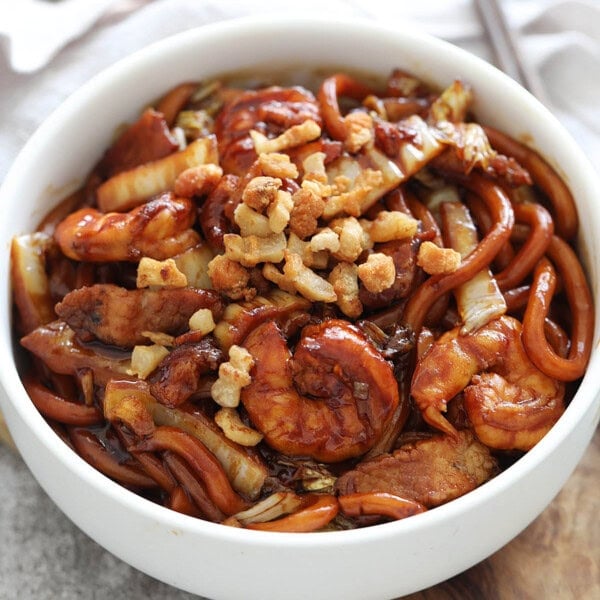
Char Kuey Teow pictures (1 of 5)
Click the image to see next picture
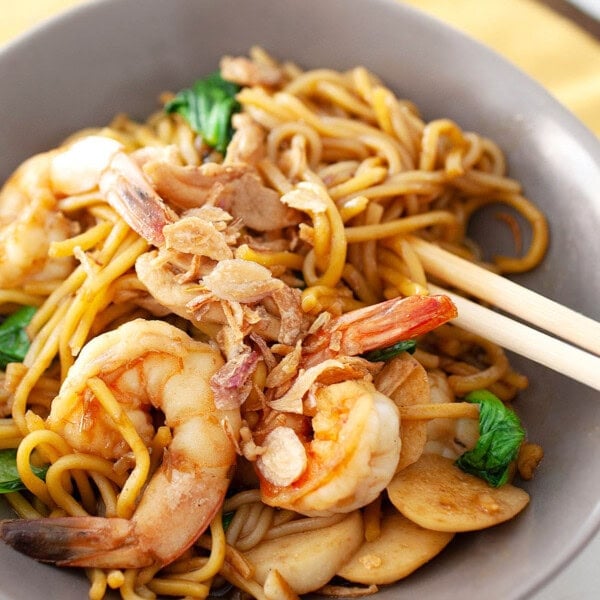
When it comes to Penang hawker food/street food, there are a few dishes that are chart-toppers: Penang Assam Laksa, Hokkien Prawn Noodles, and Char Kuey Teow. It’s hard to decide which one is the most popular, but if you go to Penang, you won’t—and don’t want to—miss these three stellar hawker food.
Char Kuey Teow is basically flat rice noodles stir-fried with shrimp, bloody cockles, Chinese lap cheong (sausage), eggs, bean sprouts, and chives in a mix of soy sauce. A great serving of Char Kuey Teow is flavored not only with the freshest ingredients, but equally important is the elusive charred aroma from stir-frying the noodles over very high heat in a well-seasoned Chinese wok.
The mouthwatering aroma is the “wok hei” or breath of wok. If you’ve been to Penang and walk on streets where there are Char Kuey Teow hawkers, you’ll know what I mean. A great Char Kuey Teow beckons you from blocks away; the tempting aroma fills the air and lure diners in from afar. The very thought of that smell is enough to set my stomach rumbling…(Get Char Kuey Teow recipe and step-by-step picture guide after the jump)
Click for more
I have many readers in Australia, thanks to the growing Malaysian expats there. Earlier this year, I invited the talented A Table for Two to guest post on Rasa Malaysia, and today, I would like to introduce you to yet another uber-talented Malaysian food blogger down under—Ellie of Almost Bourdain. Almost Bourdain is a beautiful [...]
A few weeks ago, I met Marc of No Recipes and Zen of Zen Can Cook in New York City. We had so much fun and shared deep conversations about food, blogging and our dreams over a delicious yakitori dinner. After I came back, Marc invited me to guest post on No Recipes and I [...]
Sambal—precisely cooked sambal—is a notably versatile and robust component in traditional Malaysian cooking. It’s the building block of many scrumptious and colorful Malay and Nyonya dishes and marries well with wide array of ingredients: seafood, tofu, eggs, and vegetables.
Once you master the skill of making a great sambal, you can prepare numerous variations of lusciously [...]
Nasi goreng or Indonesian fried rice is one of the most requested recipes on Rasa Malaysia. I have received many emails from readers requesting for a nasi goreng recipe. For those who are anxiously awaiting a nasi goreng post, wait no more as I have gotten just the perfect nasi goreng recipe for you.
Adapted from [...]
Look what I found today?
Calamansi. Or Calamondin, or sometimes spelled as kalamansi.
I didn’t find the tree, because calamansi or calamondin trees are everywhere here in SoCal and can be bought at Home Depot and many Asian grocery stores. I don’t have the patience nor do I have a green thumb to grow my own calamansi [...]
There is a reason why it took me over 3 years before an eggplant recipe appears on Rasa Malaysia. I am confused; first by its many names and secondly, by its different varieties, shapes, colors, and forms.
According to Wikipedia, eggplant is probably the most common name and it’s used in the United States, Australia, New [...]