Spicy Fish Custard

My favorite Nyonya sweetcake

Torch Ginger Bud

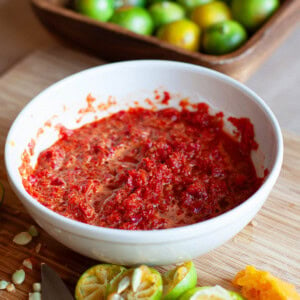
Sambal Belacan

July 17, 2009 · 44 comments

in Malaysian Food, Malaysian Recipes

Sambal Belacan
Sambal Belacan pictures (1 of 8)
Click the image to see next picture

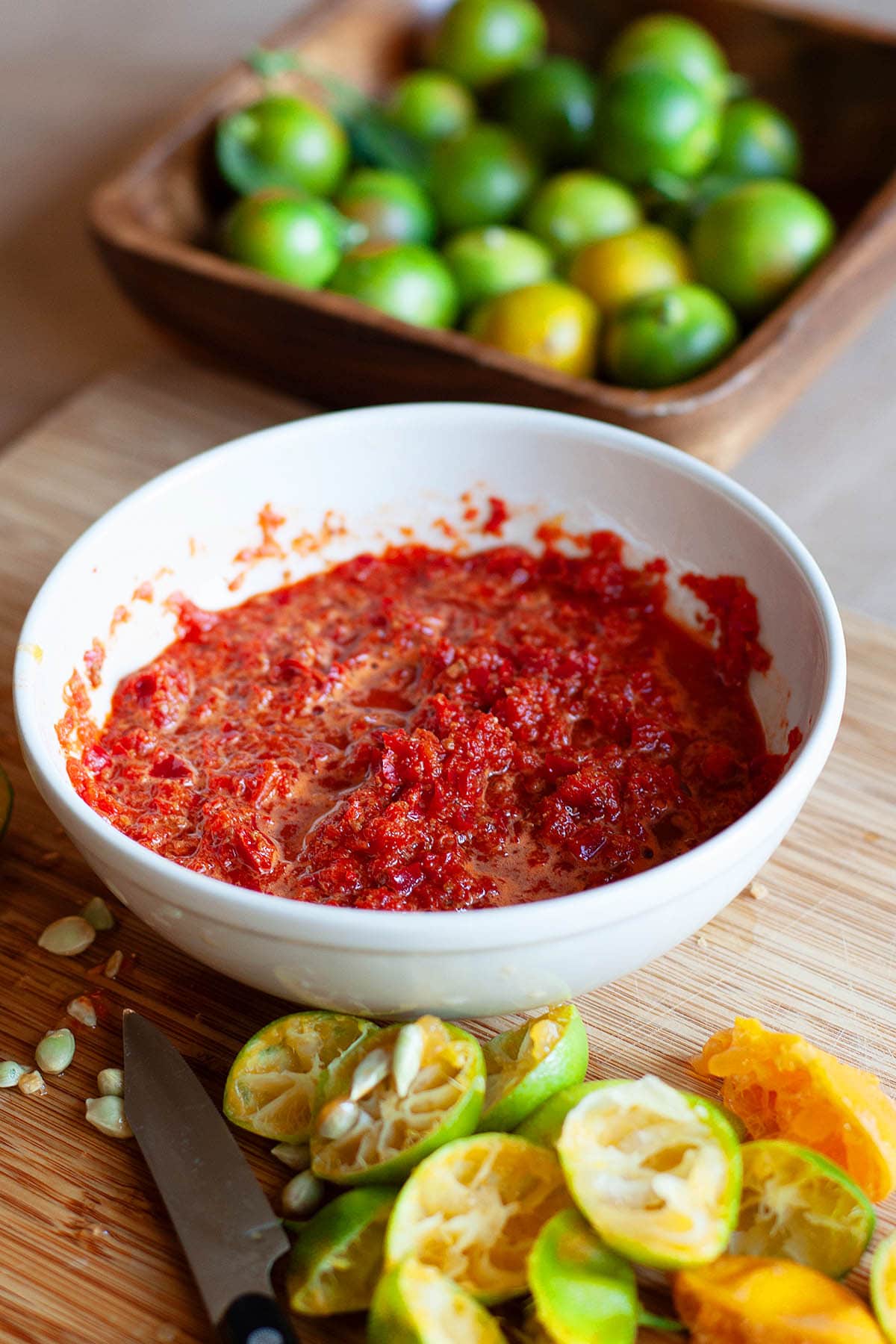
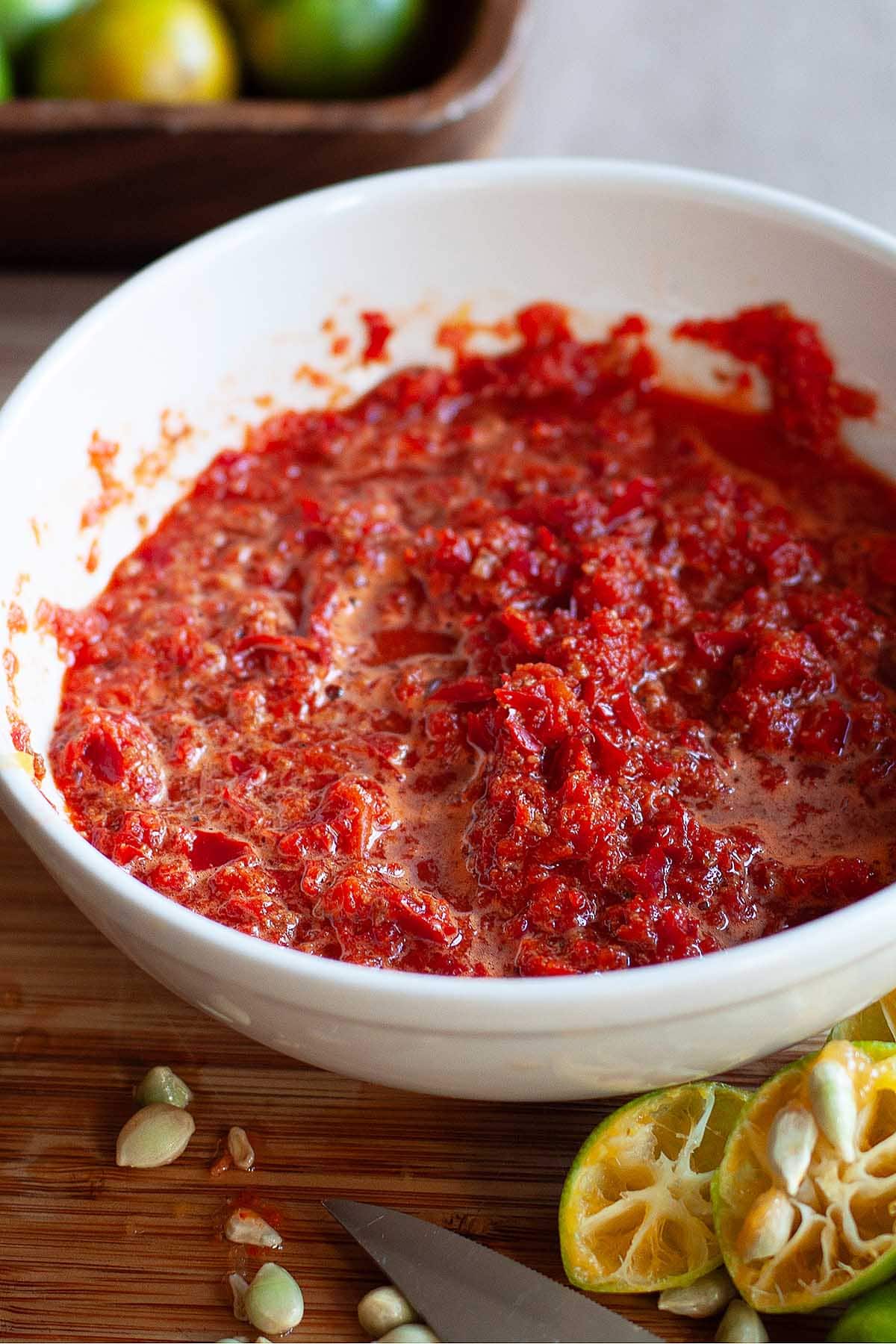
Following my recent post on sambal asparagus, I thought I would show you how to make sambal belacan from scratch–a must-have Malaysian condiment and the basic building block for many delicious Malaysian recipes.

Sambal belacan consists of chilies, belacan (Malaysian shrimp paste), kalamansi lime (limau kasturi), and salt and sugar (to taste or optional). In the US, kalamansi lime is scarce so lime can be used as a substitute. However, in reality, kalamansi lime is made for sambal and lime is inferior when it comes to sambal belacan. So, if you have access to kalamansi lime, please use it, or if you have some, please give them to me…

Sambal belacan as a condiment is something that I can’t do without. I eat my rice and noodles with it, and some Malaysian dishes such as my favorite sweet and sour eggs (masak belanda), Penang char hor fun, grilled fish with banana leaves are total awesomeness with sambal belacan.

Anyway, learn how to make sambal belacan with my recipe below and click on the gallery above to learn the step-by-step guide.

Sambal Belacan

4 oz seeded chilies (sliced thinly)
1 tablespoon belacan (shrimp paste)
1 - 1 1/2 teaspoons sugar
2 tablespoons kalamansi lime juice/lime juice
Salt (optional or to taste)

Method:

Clean chilies with running water, seeded and sliced. Transfer the chilies to a mortar.

Heat up a wok or pan on low heat and “toast” the belacan until aromatic. The texture of the belacan would turn dry and powdery after toasting. Transfer out and add to the chilies and start pounding with the pestle until fine. (Some people like their sambal belacan somewhat coarse so it’s personal preference.)

Transfer out to a bowl, add salt and sugar to taste and add lime juice (or kalamansi lime juice). Blend well. You can keep the sambal in the refrigerator for up to a few days.

Cook’s Notes:

  1. If you don’t have a mortar and pestle, you can use a mini food processor to grind everything.
  2. If you like extra fiery kick in your sambal, you can add a few bird’s eye chilies.
  • StumbleUpon
  • Google
  • TwitThis
  • Facebook
  • del.icio.us

Related Posts:

  1. Sambal Asparagus Recipe
  2. Sambal Telur Recipe (Egg Sambal)
  3. Sambal Eggplant (Aubergine/Brinjal)
  4. Grilled Fish with Banana Leaf
  5. Calamansi

Never miss a recipe again on Rasa Malaysia. Subscribe now to get updates!

Subscribe in a reader   Get new recipes via RSS and reader or subscribe via email

Enter your email address:

{ 22 comments… read them below or add one }

Cynthia 07.18.09 at 12:48 AM

This looks and sounds deliciously fiery-hot! The way you describe how you eat this is very much the same way we eat hot pepper sauce in the Caribbean.

I noticed that you did not include the seeds, was that deliberate or are the seeds not generally used? Also is there any particular chile that should be used to make this wonderful sambal?

Reply

Rasa Malaysia replied:

Cynthia - despite our origins, I guess the food culture and principle stay the same. :)

I discarded the seeds because they are very hard to pound using a mortar and pestle, plus I think there is a belief that they are not great for the digestive system. I don’t mind some of the seeds in my belacan actually because it gives some extra “texture.” I guess it’s personal preference.

Reply

KNizam 07.18.09 at 10:18 AM

check this sambal belacan picture featured in the rasa magazine - http://knizam.com/sambal-belacan-kulit-limau-nipis-terliur-la-plaks-ahaks/
so tempting. ehe :)

Reply

Rasa Malaysia replied:

Wow, that’s so beautiful. Sambal Belacan is hard to photograph!

Reply

David 07.18.09 at 11:15 AM

I am from New Zealand and recently had a chance to try out sambal belacan while traveling in Penang. I have to say that it tasted strong for my palate at the first taste, but then very quickly, it won me over. I agree that sambal belacan is a perfect dipping sauce for ikan bakar. It was probably the best grilled fish that I had ever tasted in my life. The aroma of burnt banana leaves and the sambal are simply perfect. Thanks for this great post!

Reply

Rasa Malaysia replied:

David - I am glad that you tried the ikan bakar with sambal belacan. One of the many best dishes you can try in Malaysia! Yes, I love sambal belacan with fish, without it, it’s just not the same!

Reply

lisaiscooking 07.18.09 at 3:01 PM

I think I could quickly become addicted to this, and it could be used in so many ways. Can’t wait to try it.

Reply

Rasa Malaysia replied:

Oh yes, it’s addictive. I can just eat sambal belacan as is, without rice or noodles sometimes. ;)

Reply

Kent 07.18.09 at 3:51 PM

I’ve been reading the blog for a long time - I’m a Chinese-American, and lived in Singapore for a year. Really miss the sambals from Singapore/Malaysia. Glad to finally see a recipe.

Just wondering - in US grocery stores, I can find key lime, which looks like calamansi lime. Are they the same?

Reply

Rasa Malaysia replied:

Thanks Kent for your comment. :)

Key lime is not the same as kalamansi. There are kalamansi trees for sale, but it’s scarce. You can use regular lime. :)

Reply

sydneyfoodie 07.18.09 at 11:06 PM

Hi, I live in Australia and have been reading your blog for awhile now. My mum does her sambal belachan in bulk and it keeps in the freezer for ages. She divides them up in ice cube containers. The only difference in her recipe is after cooking the belachan she adds in the pounded chilli, salt and sugar and cooks it. She does this to kill all the bacteria etc so that it will keep in the freezer. She doesn’t add the lime…..only when she’s brings it out of the freezer to use, will she then add the lime juice.

Reply

Rasa Malaysia replied:

Right, that’s the way to freeze sambal but I usually make some to last me for a few days. Adding lime when serving is right, but I don’t always have lime juice in my fridge so I add everything first. ;)

Reply

tigerfish 07.19.09 at 12:01 AM

Those kumquat trees in CNY not kalamansi lime tree hor? …….
hmmm….remember “kalamansi’ drink bring made from those limes from kumquat trees before…..

Reply

Rasa Malaysia replied:

Tiga - kumquat is different from kalamansi. Looks quite similar but still different. ;)

Reply

nyonyachef 07.19.09 at 12:57 AM

Sambal Belachan…my favorite too. Sad to hear the kalamansi is rare in US. Must find a way to preserve it. By the way,…nice mortar & pestle. Can hardly find a nice one nowadays.

Reply

Rasa Malaysia replied:

Nyonyachef - I got the mortar and pestle from IKEA, I think. I still prefer the traditional stone mortar and pestle, it’s bigger and easier to use.

Reply

Jean - OurExplorer Tour Guide 07.19.09 at 1:30 AM

The fresh red chilies look really cheerful. Interesting to see it goes into yummy Sambal Belacan.

Reply

Rasa Malaysia replied:

Hi Jean - yes, they were cheerful, as you can tell from the bright red color of the sambal. LOL. ;)

Reply

rachel ong 07.19.09 at 10:31 AM

Great post!!! when u show the pic step by step… very neat. love it!!

Reply

Rasa Malaysia replied:

Awesome. I hope to take more step-by-step pictures in the near future. :)

Reply

rachel ong 07.19.09 at 10:33 AM

kalamansi leaves it is same as kaffir leaves? how can i find all types of leaves for perut ikan.. i miss that! thank you

Reply

Rasa Malaysia replied:

No, they are different. You can get kaffir lime leaves in the US.

Reply

A Series of Kitchen Experiments 07.19.09 at 4:49 PM

Oh my, what lovely, lovely colors! You know, I’m planting some chili seeds for the winter so I can make fresh sambal from my loot hehehe *keeps fingers crossed*

Your sambal looks yummeh…I’d like to dip a cucumber into it.

Reply

Rasa Malaysia replied:

Good luck! I wish I have a small place where I can plant herbs or anything but I got my patio all sealed up in cement. ;)

Reply

david 07.19.09 at 5:12 PM

I’m pretty sure the Kalamansi you are talking about is the same as the ones Filipinos use, spelled Calamansi/calamondin though. It isn’t that hard to find if you know of a Filipino market in your area such as seafood city, or island pacific, you can purchase a whole bundle for a good price.

Reply

Rasa Malaysia replied:

David - yes, it’s the same. Not sure about the actual spelling because I have seen it spelled with k and also c. Anyway, where can I find a Filipino market in southern CA? Please let me know.

Reply

david c replied:

Yup spell it with a k, or a c all the same haha. You can try Seafood City or Island Pacific Both markets have branches in [Cerritos,Carson, LA, West Co., & Panorama] addresses are on their sites. I’m from LA & calamansi can thrive perfectly in Socal weather. We used to have a tree that bore fruit year round, so if you can try buying one for yourself go for it! The seafood city I work in sells calamansi trees, so im sure you can get one for a good price at the one nearest to you.

Reply

Rasa Malaysia replied:

David - thanks for the name of the stores. I am going to hunt them down. I wish I have a tree!!

Reply

joey 07.19.09 at 6:57 PM

Hi Bee! Thanks for sharing your recipe - we have tons of kalamansi here and it is also very popular to use as a condiment, or part of condiment sauces. I’d love to send you some but I don’t know if it would survive the trip there — or get caught on the way! What chilis do you use here if not bird’s eye?

Reply

Rasa Malaysia replied:

Joey - thanks so much but David above told me I can get them at some Filipino stores. I used regular Mexican chilies. I didn’t add bird’s eyes, only use them if I want them spicy.

Reply

Adriana 07.20.09 at 5:20 PM

Aiya! Was drooling over the recipe until I reached the point that calls for belacan. I don’t have belacan :(

Reply

Rasa Malaysia replied:

Hah, I need to stock up my belacan the next time I go home. I am running out. I don’t trust the belacan sold in the Asian stores here in the US. ;)

Reply

food-4tots 07.21.09 at 3:38 AM

You are making me mouth water looking at the samban belacan. It’s my all-time favourite!!

Reply

Nishi 07.25.09 at 7:55 PM

Yum…it’s a good thing I made instant noodles before coming across this page. You’re really making miss home right now. I always bring about three bottles of sambal belacan back to AUstralia when I’ve gone home

Reply

Rasa Malaysia replied:

Yes, sambal belacan is so good. No trouble smuggling into Australia?

Reply

Nishi replied:

Eh, I think with the amount of Malaysian living and studying in Australia now, the custom officers can’t be bothered fighting anymore. A friend of mine actually managed to bring in home made belacan!

Reply

Rasa Malaysia replied:

Hah, that’s true. Maybe the immigration offer is Malaysian, too. Hehe.

Reply

Nishi replied:

haha…you’re probably right

Reply

Verdegrrl 07.29.09 at 10:39 AM

Great topic! Thanks! My FIL eats fresh sambal with almost every meal.

My fav is the stuff served up by a small restaurant chain in Singapore called Sanur. It packs a wallop that doesn’t immediately strike - instead building gradually until you’re almost crying. But it’s so good you just need one more bite! And another. And another.

If anyone has an approximation of that recipe, please share!

Reply

Mel 08.25.09 at 4:12 PM

Your recipe call for seeded chillies. What type of chili do you use? I have been searching for red chilies (like the one we have back home in Malaysia) for a while now but I just can’t find them!

Your recipe looks simple and can’t wait to try it!

Reply

Rasa Malaysia replied:

Hey Mel - if you are in the US, it’s very hard to find the kind of chilies found in Malaysia. You can use any kind of red chilies.

Reply

amira 08.26.09 at 2:31 AM

Thank you for posting this lovely recipe…I haven’t had sambal belacan for few years now, thus I decided to make sambal belacan today to accompany it with some vegetables. Although I had to substitue kalamansi lime for normal lime juice it turned out great. Wonderful!

Reply

Anna 09.24.09 at 11:45 AM

You can buy frozen kalamansi from any Filipino store.

Reply

Jessica Lee Binder 10.20.09 at 10:52 AM

I love Belecan! Do you usually buy it or can you make belecan from scratch?

Reply

Leave a Comment

You can use these HTML tags and attributes: <a href="" title=""> <abbr title=""> <acronym title=""> <b> <blockquote cite=""> <cite> <code> <del datetime=""> <em> <i> <q cite=""> <strike> <strong>

Previous post: BBQ Ribs Recipe

Next post: Chicken Fried Rice