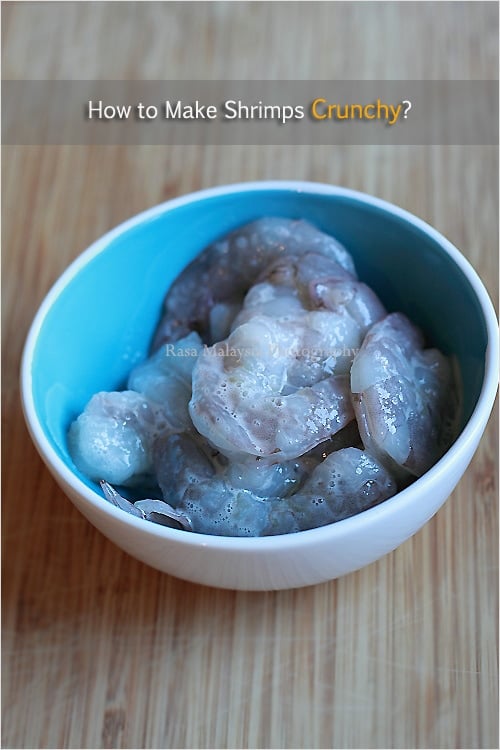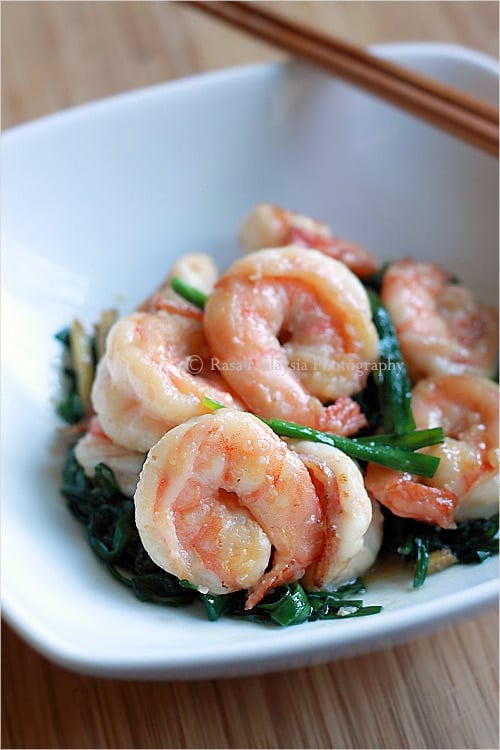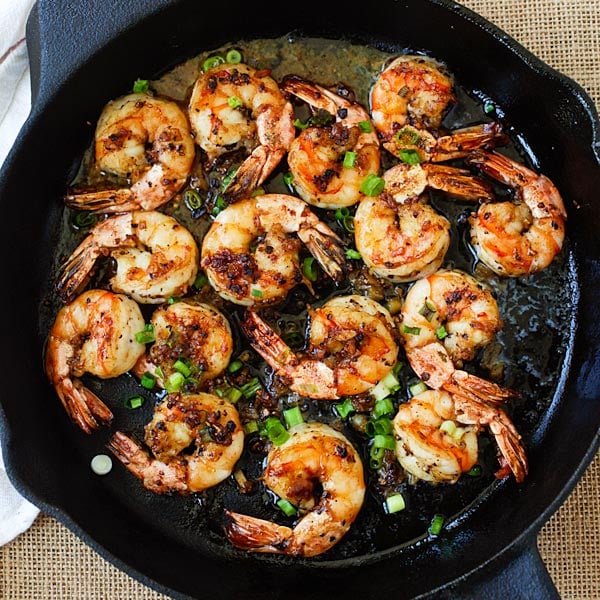
How do you make shrimp crunchy? More precisely, how do you make shrimp Chinese-restaurant-crunchy?
I’ve been obsessed with this subject matter for the longest time–a topic that took me a while to research. If you’ve tried dim sum or shrimp dishes in Chinese restaurants, you know exactly what I mean–shrimp so crunchy they give a mouth feel that they “bounce” in your mouth as you sink your teeth into the firm flesh. In Chinese, it’s called 爽脆 (shuangcui).
Great Chinese food is all about texture and mouth feel (口感) of everyday ingredients, the most basic skill that a good Chinese chef should acquire. My uncle in Hong Kong is a huge connoisseur and a fantastic cook; he taught me the secret technique which he learned from a Cantonese top chef in Hong Kong–water. Yes, cold running water to rinse shrimp (up to hours) until the flesh firms up and becomes translucent. I have later confirmed this technique with a few kitchen workers in Chinese restaurants, and yes, it’s true…(learn the secret technique of making shrimp crunchy after the jump)
I tried the cold running water technique at home and it works. However, it’s not ideal for home cooking because too much water is wasted during the treatment process. I resolved to research further for an alternative method best for home cooks.
When I was in Beijing this June, I chanced upon a great Chinese cookbook with the best step-by-step picture guide of making har gow or shrimp dumplings. It reveals that a pH9 alkaline water is the secret behind crunchy shrimp, and a light massage while marinating pretty much does the trick. The PH9 clue intrigues me. I came back and went to my favorite Chinese restaurant in Irvine and investigated further. The chef told me that they don’t use alkaline water, but swear by the process of marinating shrimp with egg white, tapioca starch (菱粉) and baking soda, a process they called “上浆” (shangjiang) or literally “coating with starch.”
I researched further about pH9–which is a scientific measure of the acidity of a solution. Anything that is more than pH7 is alkaline. I found out that tap water–depending on its source, origin, or location–is usually close to pH9, which explains the reason why cold running water is used by Cantonese chefs. Sea water is pH8 and the reason why live/raw shrimps have firm and crunchy flesh. I also learned that baking soda and egg white are both pH8. At that point, everything becomes crystal clear to me.
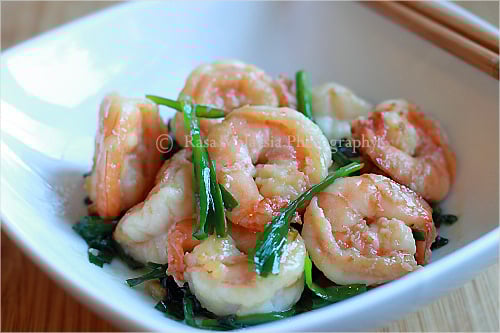
So, here it is, the technique that you’ve been waiting for–a well-protected “trade secret” used by Chinese and Cantonese chefs to treat their shrimp, which I have adapted and modified for home use. I’ve tested it many times in my kitchen and it never fails me. I made my shrimp and chive dumplings with texture exactly like the ones served at dim sum restaurants. I made a stir-fry shrimp dish and the shrimp bounced in my mouth and “crunched” as I bit into the flesh. This technique works like a miracle!
If you know another technique that works well, please share with me via comments! Otherwise, try my method below and you will be serving jumpy, bouncy, and crunchy shrimp in no time!
Ingredients:
1 lb peeled and deveined shrimp
1 tablespoon egg white
1 1/2 teaspoon tapioca starch (菱粉)
1 heap tablespoon baking soda
Method:
- Peel, slit the back of shrimp, and remove veins
- Transfer shrimp into a big (deep) bowl and add ice cold water from your fridge–you can also use regular tap water and add some ice cubes to it. Make sure the shrimp are submerged in water.
- Add 1 heap tablespoon of baking soda into the bowl and lightly massage the shrimp with the baking soda water. Set aside for 30 minutes.
- Rinse the shrimp thoroughly with cold running water.
- Pat dry with paper towels. By now, you should see that the shrimp become somewhat translucent in appearance.
- Add egg white and tapioca starch to the shrimp. Use your hand to blend well while lightly massaging the shrimp.
- Cover the shrimp with plastic wrap and marinate overnight.
Cook’s Notes:
- Marinate the shrimp overnight for lunch serving or marinate in the morning for dinner use.
- The shrimp you use have to be somewhat fresh to begin with. If you have stale shrimps, then sorry, pH9 will not save your shrimp. ;)
- Baking soda is also the secret ingredient Chinese chefs use to make meat tender. You can learn it in my Cashew Chicken recipe.
- Last but not least, I add a wee bit of baking soda in the batter to make fried foods extra crispy and airy. You can learn more in my sweet and sour chicken recipe.
.
BRAGGING RIGHTS AND SELF PROMOTION
I am on Saveur’s “Sites We Love” at number 27, right after the big wigs such Apartment Therapy’s The Kitchn, Gourmet, and Culinate!! Thanks to the team at Saveur, I love you guys!!
I am also one of the “55+ Foodies to follow on Twitter” on Mashable. Go Rasa Malaysia!
Get new recipes via RSS and reader or subscribe via email


{ 56 comments… read them below or add one }
Due to different kind of oil that I use in Canada, I also found that baking soda is perfect to make my deep fry stuff crunchy.
Reply
Rasa Malaysia replied:
Pepy – baking soda does make fried foods crunchy. Also, it tenderizes meat.
Reply
Thanks for the tip B..hey if your ever near tustin(the district) you should try blue water grill..really good
Reply
Rasa Malaysia replied:
I thought Blue Water Grill is in Newport Beach?
Reply
Sounds interesting and will try. Have you tried it with other protein? Chicken? Beef?
The method a lot of cooks I know (and myself) use is to use cornstarch as the “flouring” agent right before cooking, especially if stir-frying or frying in general. Have only done it with chicken/beef/pork. Not sure how shrimp would work. But cornstarch itself for getting crispiness as well as barely any coating works wonders. Have you tried just using cornstarch? Season/marinade your shrimp as desired, dust w/cornstarch and add to a hot skillet or oil. Let me know how this works for you. Will try your way w/ shrimp & other proteins.
As a baker I do see how the egg whites work. I use egg whites when toasting/roasting/candying nuts because not only does it help any seasonings stick, it also make them extra crunchy.
Reply
Rasa Malaysia replied:
Yes, baking soda works for meat, too. You can check out my cashew chicken recipe for reference: http://rasamalaysia.com/chinese-food-recipe-cashew-chicken/
Corn starch doesn’t make shrimps crunchy, it just seal the outer layer to make it smoother. Corn starch works on meat to make it tender but not on shrimp. And yes, corn starch is great for frying.
Well, try this, it works for me. And you can get the mouth feel I was talking about, the shrimp basically “crunch” and “bounce” in your mouth when you bite into it. It’s awesome!
Reply
for step 2, how long do you need the shrimps under water? just a quick rinse?
Reply
Rasa Malaysia replied:
For 30 minutes in baking soda ice cold water.
Reply
Fascinating, B. Thanks for sharing. I’ve never used baking soda before in this application, and I’ve usually used cornstarch. I can’t wait to try this!
Reply
Rasa Malaysia replied:
Cornstarch just makes the outer layer smoother but it doesn’t make shrimps crunchy.
Reply
In the 80s when I was an expat’s wife in Singapore, I took some dim-som classes. IF I remembered correctly all one has to do is marinate the shrimps with a tea-spoon of sugar for about 10 min. Rinse, add seasoning and cook. I actually prefer shrimps in their ‘normal’ form therefore have not used this method since then. Hope it is good.
Reply
Rasa Malaysia replied:
Marinating shrimps with sugar would make the shrimp sweet. All the famous Char Kuey Teow stalls in Penang do that.
Reply
by the way, all these soaking and rinsing, would it not remove the natural taste from the shrimps?? Just curious. My mother would only allow us to wash shrimps ONCE!
Reply
Rasa Malaysia replied:
Well, no it didn’t since you soak in the baking soda for only 30 minutes. In Chinese restaurant, they would rinse the shrimps up to 2 hours, and hence all the flavors are gone and they have to use seasonings to put back the flavor. This is what my uncle told me. ;)
Reply
Aha! The secret of prawns’ magic crunch. Can’t wait to try it. Hope that it works with frozen prawns. I miss fresh prawns which are abundant in Malaysia’s wet markets.
Thanks Bee!
Reply
Rasa Malaysia replied:
Yes, it works with frozen prawns. All the prawns we get in the US are frozen. I miss my Penang wet market. :(
Reply
Steph replied:
i’m just glad to know it works for frozen prawns!! thanks for sharing that tip! :)
Reply
Rasa Malaysia replied:
Awesome, hopefully you will try it out.
Reply
Thanks for sharing those trade-secrets and indeed – go Rasa Malaysia!
Reply
Rasa Malaysia replied:
Thanks Cyn.
Reply
Wow, scientifically PH 9 somemore! Thanks for sharing ! Yours is much easier.
Reply
Rasa Malaysia replied:
Cariso – yes, when I read that cookbook in Beijing, I was so excited. Really serious and secret tip!
Reply
Very interesting love the insights as I know my mouth feel on my shrimp was sadly lacking. This technique sounds perfect, and I look forward to trying it soon.
Also kudos on the recognition – definitely well deserved.
Reply
Rasa Malaysia replied:
Correct. All shrimps are frozen in the United States unless you buy the fresh and live shrimps in Asian super-markets. This technique would firm up the flesh. Let me know if it works out for you. :)
Reply
Great tip! I’ll try this one at home! Nom nom nom nom!
Reply
Rasa Malaysia replied:
Awesome, let me know how it’s working for you. :)
Reply
My family technique is a real simple one. Use coarse salt and massage into prawns, rinse. Then, rub prawns with corn flour. Rinse the prawns until the water is clear.
Reply
Rasa Malaysia replied:
I have tried this method many times before but salt and corn starch doesn’t work for me at all. Perhaps because of the frozen prawns. My method makes shrimps “garing” basically.
Reply
mycookinghut replied:
Usually, I try to get hold of fresh prawns.Anyway, I will try your method. Thanks for sharing!
Reply
Rasa Malaysia replied:
Leemei – unfortunately, all the prawns in the US are sold frozen, and sometimes, the flesh is “lempek” even if they look fresh. :(
Good luck trying it.
Reply
Ah…great tips! You know, I actually did this process by accident i.e. rinsing the frozen prawns in cold water a good few times until the water runs clear and the prawns are clean looking as I don’t like the particular prawn stench has (irony) thought I like prawns.
I used the prawns in wontons a lot of times and they tasted bouncy without having to use baking soda and egg whites. However, this entry really opens up my eye and I will definitely try it in my next wonton batch.
Cheers!
Reply
Rasa Malaysia replied:
Yes, rinsing shrimps with lots of water does the trick.
Reply
I love prawns and all my stirfries will have lots of prawn. Now I will get crunchy prawns instead of lifeless one. Thanks for sharing a very valuable secret. I appreciate your kindness in sharing.
Reply
Rasa Malaysia replied:
You are right. Not sure where you are at, some of the frozen shrimps in the US are pretty lifeless after cooking.
Reply
Hi there
I wonder if soaking/rinsing the shrimp in water strips them of their natural flavours. I ask because I have found these soaked/rinsed specimens to be utterly devoid of flavour compared to their fresh/live compatriots. Almost tasteless/plain like water, I nicknamed them “water prawns”. I have learnt to recognise these specimens by their slight translucent nature even when cooked and of course, their very crunchy texture.
In my book, I would sacrifice a little texture in return for some flavour.
Reply
Rasa Malaysia replied:
Ping – my shrimps were flavorful and still sweet with this treatment.
Reply
I’m curious about how the chemistry behind this works.
I’ve found that a short soak in a saltwater solution gets a pretty good texture. I’ll have to give this one a go to compare.
Reply
Rasa Malaysia replied:
Somehow salt water never works for me. Not sure if it has to do with the salt I used. If anything, rubbing my shrimps with salt just breaks it down even more. :(
Reply
thanks for the tip. am making seafood hor fun for dinner tonight, going to try your technique.
Reply
Rasa Malaysia replied:
Cool, let me know how it goes.
Reply
Thanks for the tips! I defnitely will put these tips to the test as I always wanted my shrimps to taste just like the ones in restaurants. Thought it was the freshness of the seafood and maybe the very very hot wok they use.
Btw, I’m new on the blogasphere with my own blog – http://www.bakerellaz.blogspot.com – where me & my partner make cookies, cakes, hors d’oeuvres to order. Hope you will enjoy reading it.
Reply
Have been checking your blog for some time now. There was a drawn out discussion of culinary use of chemicals in e-gullet a few years ago. Substances that we do not ordinarily associate with food because of extreme toxicity. One of these is borax (sodium borate) that is used to crunchify shrimps and prawns. There is a severe interdict on its use apparently but given the capricious enforcement of regulations in China, I have become wary of suspiciously crunchy decapods.
Reply
Rasa Malaysia replied:
Apicio – you are absolutely right. When I was doing research, I found out that BORAX is exactly PH9 and immediately thought that some Chinese restaurants must be using it. I try to make my method as “natural” as possible, and that’s why it involves soaking it in baking soda water and then rinse it thoroughly with cold running water, and then coat it with egg white and tapioca starch. Thanks for sharing the discussion on e-Gullet.
Reply
Rasa Malaysia replied:
Apicio – your mention of borax also clears up a question that I always have. Some peeled frozen shrimps are crunchy and bouncy right out of the box, with the body so slippery and almost translucent looking, but the shrimps have pretty much lost all the natural taste. I suspect those shrimps are chemically treated with borax, because borax is precisely the ingredient used in washing detergent. Yikes!
Reply
Hi Bee,
Thank you for sharing your crunchy prawns secret with us. I, too, have heard of the running water technique some years ago but coming from Melbourne, Australia, with the continual water shortage, I’ll probably get arrested for wasting it that way. Your alternative method sounded interesting and I shall most certainly give it a try. By the way, care to touch on the secrets for smooth and tender beef, commonly found in Chinese dishes?
Keep up the good work. You are doing great !!
By the way, keep up the good work.
Reply
Rasa Malaysia replied:
Pinenuts – agreed. There is one thing about making our ingredients great, but wasting water is not the mean to get to it. Do try my method and let me know how it goes. :)
Reply
Thanks for sharing the secret. I’m going to try this.
Reply
Rasa Malaysia replied:
Let me know how it goes.
Reply
Here in Australia we have two different products – bicarb soda and baking powder. So I am wondering which one to use? I presume the former? Thanks for the tip.
Reply
Rasa Malaysia replied:
Yes, it’s the former.
Reply
I learned through a co-worker how to make my shrimp crunchy and this simple technique truly works as I’ve tried it so many times and I just loved it. First, of course, the shrimp must be fresh and washed. Then, it must be dry. With or without the shell, using clean paper towels, pat dry all the shrimp making sure you have squeezed out all the water. I’d line them up in a platter and refrigerate uncovered for about an hour to make it even more dry. Then cook it on high heat with a little bit of cooking oil. Water in the shrimp is what makes it soggy.
Reply
Rasa Malaysia replied:
This is a real simple technique. I will have to try it the next time. :)
Reply
Ah! The secret have been waiting for :) Thanks for sharing! This is always what I want to achieve with my shrimps…hooray!
If I can’t find tapioca starch is there any substitution?
Reply
Rasa Malaysia replied:
I think corn starch works, too, but I am sure you can find tapioca starch in PH. I am not sure, but the Chinese chef specially told me “tapioca starch.”
Reply
joey replied:
Thanks! Will look around :)
Reply
Can’t wait to try this out. Thanks for doing the research on this! :)
Reply
Rasa Malaysia replied:
Hey Veron – I am not much a “research” person but I love shrimps, so that’s why I was very into the subject matter. Hehe.
Reply
Thanks for sharing the insider secret! I have to try it out =D
Reply
Rasa Malaysia replied:
Noobcook – let me know if it works for you. :)
Reply
You rock!! I love you for this tip :) Thanks. You are always *awesome*!!! xxoo
Reply
Won’t the sodium bicarb impart its flavor on the shrimp? I really hate the flavor of baking soda – the reason why I never liked scones. Marinating shrimps in baking soda might give it some “baking soda flavor” might it not?
Reply
Rasa Malaysia replied:
No taste, you have to rinse it out.
Reply
Rasa Malaysia, this is a great post. Thanks for the tips. I will try to impress my guests with crunchy prawn in har gow next. Great
Reply
Rasa Malaysia replied:
Ooooh, let me know how it goes. Yes, I am going to use this to make har gow.
Reply
Congrats Rasa Malaysia on both achievements with Saveur & Twitter!!! It’s about time!! :D
Great tips about the crunchy shrimp…I’ve always thought they added some sort of preservatives. So good to know it’s all natural.
Reply
Rasa Malaysia replied:
NPM – I am sure some of them used Borax or whatever, but my method is natural. Well, at least baking soda is rinsed off with water…hehe.
Reply
You have great Asian recipes on your website. I hope I found your site earlier. You have great photography too. Regards.
Reply
Rasa Malaysia replied:
Divina – thanks so much! Do come back and visit often.
Reply
Hi, what great photos and ideas, thank you. I am interested in the name of the Chinese cookbook you found, could you please share the name of it? THANKS!!
Reply
Rasa Malaysia replied:
Lee – I actually left that cookbook back in Penang, Malaysia and don’t have it with it. It’s just a very common Chinese cookbook but it is the first time I read about the PH9 tip!
Reply
I feel almost guilty to know about this secret Bee! You should call it the no-limp-shrimp secret. This is really cool, i didn’t know about this technique but i’m gonna give it a go as soon as possible.
And yes! Rasa Malaysia kicks ass! :)
Reply
Rasa Malaysia replied:
Zen – yes, you are right, I need to trademark this!! Let me know if it works for you. A few readers have already tried with great success!! :)
Reply
I have an filtered ionizer . One source of the water is acidic and one is alkaline. The alkaline water is for drinking and the ph is more than 9. When I use the PH tester to test, the colour is deep blue to purple. SinSince my water is already alkaline, do I still have to add baking soda in the water when I soak the prawn ?
Reply
Rasa Malaysia replied:
Hi Lee – I am not sure. Why don’t you try it out and let me know which method works best for you. You can split your shrimps into two batches and try out side-by-side. I am curious to know, too. :)
Reply
I’ve been an avid reader of ur site. Hubby’s malaysian so ur recipes are so useful. :) And I just tried this crunchy prawns mtd yesterday to make kung po shrimps. It works and I’m so happy. Tks so much for sharing. :)
Reply
Rasa Malaysia replied:
Ash – that’s awesome. Yes, this crunchy shrimp technique will work very well for Kung Pao Shrimps. Yummy!
Reply
It works! You’re great!! Thanks for sharing the trade secret!!
Reply
Rasa Malaysia replied:
Mommy Leong – yay, I am so happy. Yes, this method is great, it has never failed me. :)
Reply
Clever girl. This is fascinating and thank you for the great info. I have always wondered about this.
Reply
Rasa Malaysia replied:
I know, that’s why I researched this subject matter because I wanted to know.
Reply
I am never good with prawns, I always encountered the translucent prawn in western countries and I thought it’s either from different breed or it’s from the pond. Haha ! Thank you for opening my eyes.
Can this method be used for cooking Assam Prawns ?
Reply
Great tips! Now to find some really fresh shrimps.
Reply
When I was taught cooking from a chinese chef from Shanghai he also told me that baking soda can also cause crispyness when added to a batter.
Hence I did a lil research and discovered that baking soda can differ in different countries. In my country I had to switch to Natron bicarbonate which is sort of the same as bakind soda. But it doesnt give thise bad after taste. I hink the natron is refered to “Bicarbonate of soda” or something. At least baking powder and soda had a bigger difference than people think.
But this technique is definitely interesting and I will definitely give it a try.
Reply
Rasa Malaysia replied:
Yes, in Malaysia, baking soda is marketed as soda bicarbonate. Baking powder is different from baking soda.
Reply
Thank you for this invaluable secret, I tried it for our dinner tonight (I made stir fried shrimp with asparagus) and it was bouncy & had that crunch we always get from big chinese restaurants!!!
Reply
Rasa Malaysia replied:
Awesome, I am glad it works for you. Yes, this trick has never failed me.
Reply
I TOTALLY agree with you on the shrimp texture when it comes to “great Chinese foods”!!! It does make the dish tastes soooooooo much better! A local chinese restaurant in california made the most delicious and wonderful wonton which I’ve never failed to eat there whenever I have the chance to visit California. The texture of the shrimp of the wonton is incredibly crunchy, it was amazing! I could devour a dozen of those wontown in one sitting! So trust me, when I saw this post, I was beyond thrill! I HAVE to try your recipe!
Thanks!!!! LOVE LOVE LOVE your web site!
Reply
Rasa Malaysia replied:
Adelina – yes, the best shrimp wontons have to be crunchy and bouncy. If you don’t have that texture, it’s simply not great.
Reply
When I first read PH9, I thought you were referring to some unusual compound. I would totally have recognized it immediately if you had used the much more common convention of using a lower case P. As in, pH 9 or pH 7.
Reply
Rasa Malaysia replied:
LOL I am not a scientist and didn’t know that the p is supposed to be lower case. Thanks for pointing it out to me.
Reply
I wonder why do you put tapioca starch to it, cause I just read it is acid :/ I’m from Brazil and I can find two kinds of tapioca starch here: polvilho doce and polvilho azedo. The azedo one is more acid than the other, but they are both acids. I’m confused now :(
Reply
The term for this method is called “velveting”. I’ve always gently rubbed my shelled prawns with cornflour then (as I also live in Australia where we have to watch our water consumption) I rinse my prawns in water in a bowl until clear. It always works for me!
Reply
Rasa Malaysia replied:
Lyn – yes, rinsing with water works but could be a little hassle.
Reply
What should I do if I want to make scrimp salad? I want to boil them instead of frying. After I marinate them. If I want them boil, Wouldn’t the marinate come out?
Reply
Rasa Malaysia replied:
You can boil them.
Reply
Rasa Malaysia replied:
Well, no it didn’t since you soak in the baking soda for only 30 minutes. In Chinese restaurant, they would rinse the shrimps up to 2 hours, and hence all the flavors are gone and they have to use seasonings to put back the flavor. This is what my uncle told me. ;)
Thanks for this tip to make the shrimp crunchy. What type of seasonings make the shrimp more Shrimpy? Seems like restaunt shrimp has something extra to give it a very pronounced shrimpy or ocean taste. Thanks again,Bookmarking site
Reply
Rasa Malaysia replied:
Try adding fish sauce.
Reply
Do you, by chance, have the Salt and Pepper Shrimp recipe (Cantonese style)? I’ve tried so many techniques just to get the right texture/crispiness of the batter and shrimp. What I’m after is the light crispy coating that these restaurants use to batter the shrimp. I’ve even tried tempura batter flour but does not come out right.
Btw, thanks for the tip, I will definitely try this technique out..
Reply
Rasa Malaysia replied:
Sorry, I don’t have salt and pepper shrimp recipe yet.
Reply
jean replied:
i gave this recipe a go last night. i did have to replace the tapioca starch for cornstarch so not sure if shrimps were supposed to turn out like it did last night. i plan to buy more shrimps and this time will grab some tapioca starch.
thank you again rasa! :)
Reply
Thanks for your secret! This method is WONDERFUL. I used it twice over the weekend and my shrimp had the most unbelievable texture.
Reply
Rasa Malaysia replied:
Carmen – that’s great!
Reply
I have a question… after marinating the prawns, do I wash the marinate away if I want to steam the prawns?
Reply
Rasa Malaysia replied:
I think you can leave the marinate on.
Reply
I would like to know why add tapioca starch to the shrimp?
If I want to fry the prawn should I wash the prawns again with cold water after taking them out rom the fridge?
Reply
Rasa Malaysia replied:
You don’t have to wash. Tapioca starch makes the shrimp crunchy!
Reply
Hi 2 more questions
1. to leave the prawn in baking soda water and set aside for 30 minutes, should it be in the fridge? or room temperature?
2. simialrly, to marinate overnight, is it to leave the prawn in the fridge or room temperature?
Reply
Rasa Malaysia replied:
1) Room temperature or refrigerator is fine.
2) In the fridge.
Reply
Thank you for this wonderful tip. I tried it and the prawns real good and crunchy. May I know if I do not deshell the prawns would the same method work. If not, could you advise what needs to be done. Aslo, is it necessary to wash away the marinate
Reply
Rasa Malaysia replied:
Well, you can try with the shell on and let me know. I haven’t tried so.
Reply
I had this wonderful creamy coconut sauced shrimp. At a local chinese restaurant in Florida. I am addicted it it..It tastes like coconut, I think they use coconut milk. its very smooth, not grainy at all from raw coconut , and maybe they use condensed milk with, cream de coconut or coconut milk it..? ITS NOT fried Shrimp..its a coconut base shrimp.very creamy. And have never had it anywhere else..ay chinese restaurant in USA.
I would love to have this recipe, if anyone knows of it. Helpppppppppp :-)
I also would love a Chinese lemon chicken and orange chicken recipe..my other favorite restaurant closed,There’s was the BEST I’ve ever had…seems like they used boneless chicken breasts coated lightly and cooked, then cooked again in a fresh lemon thick sauce…Was Awesome!!!
Thanks in advance
KEEPMEPOSTEDOK@AOL.COM
Reply
Thanks for this tip. I was precisely hunting for this information as we are going to have a dumpling party tonight and my guest does not eat pork (so we have to make them with shrimp). I usually do not like to make dumplings with shrimp as the texture has always been disappointing. I am going to try soaking them in ice cold water. The last time I made some Lebanese style shrimp I put the peeled shrimp on a bed of ice (which turned into ice water eventually) and the ones that were submerged became transparent. I was wondering why some of them were transparent and some of them were not. Well, you’ve answered my question….so thank you. :)
Reply